
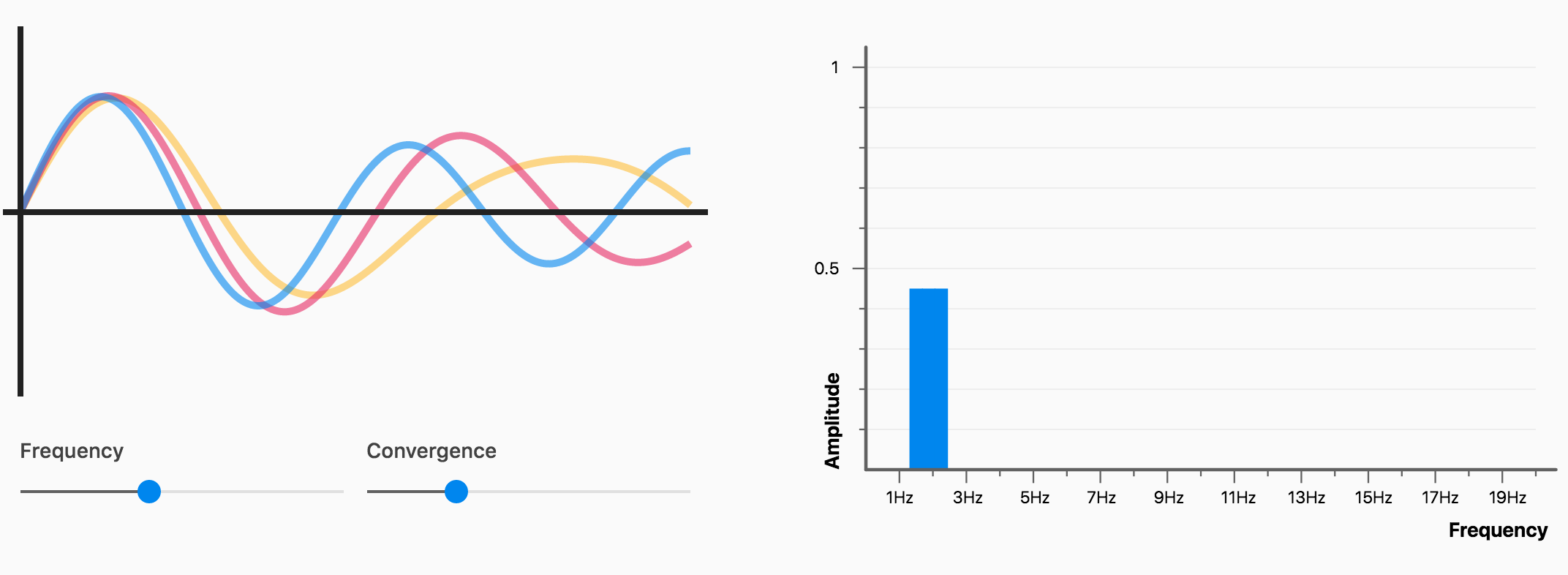
objective approach There seems to be a lot of "magic" in the land of audiophiles. The reality is that no matter how what a manufacturer claims their product sounds. I plan to write more educational pieces. cracks and pops What are you actually hearing when a bow runs across a cello? It's all about them sine waves. Sine waves are the fundamental building blocks of sound. When listening to the strum of multiple strings in a guitar, you're essentially listening to a convergence of multiple sine waves. Essentially, everything we hear could be produced by adding a bunch of sine waves together. The characteristic timing and amount of air displacement caused by this waveform determine what we hear and how loud we hear it.
Sine, triangle, square, and sawtooth periodic waveforms produce a constant tone. The higher the frequency of these waveforms, the higher the pitch. Aside from a sine wave, each of these waveforms has harmonics, which, in addition to its fundamental note, combines additional frequencies at various amplitudes. For example, a square wave will have more high-frequency harmonics thus will sound "brighter" than a triangle waveform. So when you're listening to a string section of an orchestra, how this group of strings vibrates determines the complexity of its waveform and its associated harmonics. What we actually perceive is determined by the timing and displacement of this waveform when it arrives at our ears. In an unamplified live performance, we absorb the pure tone and timbre of the voices, kick drums, cymbals, and saxophone. When this performance is recorded onto digital media, many things could happen. Of course, this waveform could arrive at each ear at different times. The left and right ear could hear differences at least 10 microseconds apart which allows us to localize sounds. This is why musicians, sound engineers, and audiophiles value precise waveform reproduction in their stereo recording/playback equipment. It's the difference between flat and unfocused soundstage and one with pinpoint imaging and depth. The motivation of this post was Josh Comeau's interactive project on waveforms. This is an incredibly fun and informative work which requires no technical know-how.An Interactive Exploration of Sound
Enjoy the content? Support Audio Bacon: