
Farad Super3
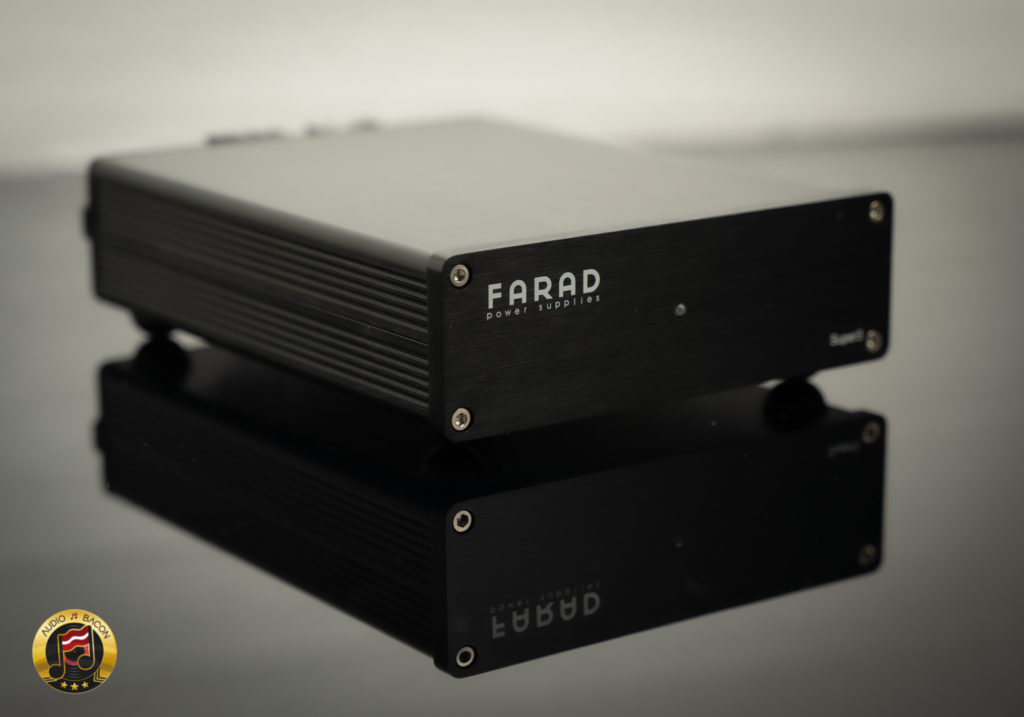
Price: $577 (Single rail)
Build & Specifications
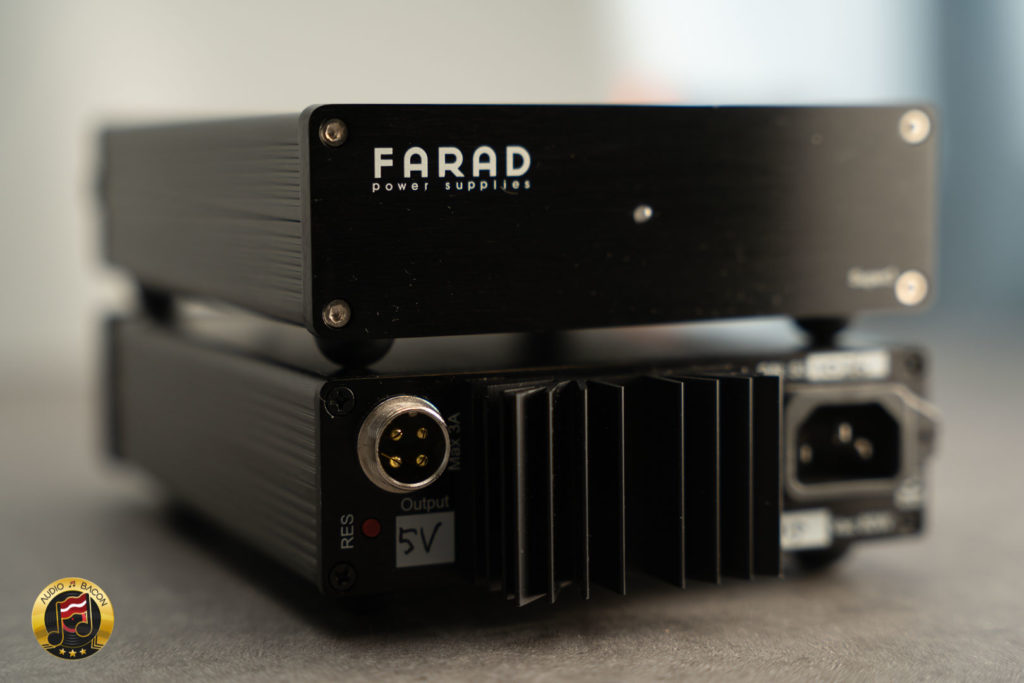
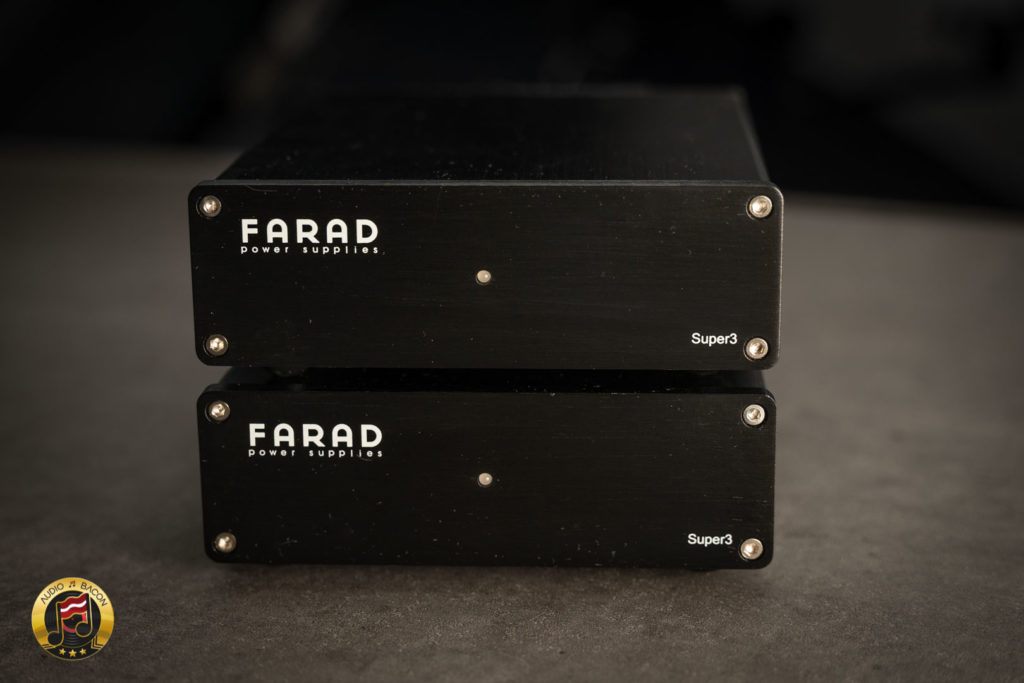
This power supply has by far the smallest footprint and is also the lightest of the entire shootout.
- The Farad Super3 Power Supply is a double regulated 3A super capacitor linear power supply.
- A Farad LPS is built for long durability at 24/7 operation with the best sounding A-brand parts inside. Read about the technical background of a Farad power supply here.
- The Super3 linear power supply is standardly delivered with a quad pole 18 AWG tin plated copper DC power cable of 50cm length terminated with a choice of 5.5/2.1 or 5.5/2.5 mm barrel connector.
- For an extra upgrade, different connectors and different lengths we offer our Level 1, Level 2 or Y-Split DC power cables. We also developed a AC power cable specially for our power supplies.
- For a significantly better performance we recommend the HifiTuning Supreme3 silver/gold and Synergistic Research Orange fuses. Also we can upgrade the stock AC-inlet to a Furutech Rhodium AC-inlet. Any of these upgrades will be installed during build of your supply.
- GX16-4 output on DC cable
Overview
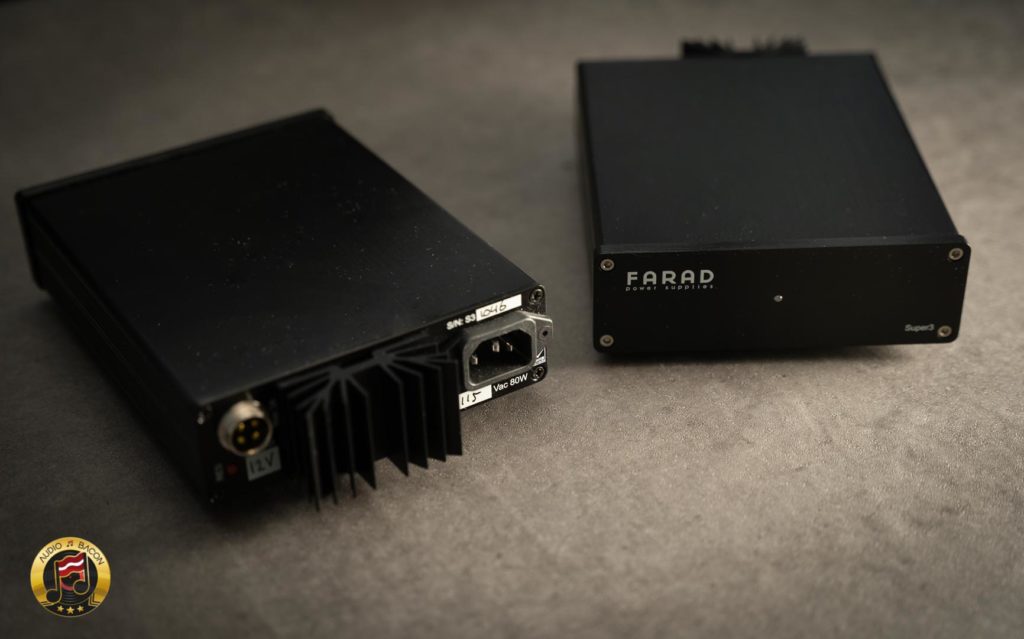
First, I like how small yet dense this power supply feels. Many will find the form factor (less than 1/3 the size of most of these power supplies) very attractive. Especially for smaller racks, desktops, etc.
I'll be using the Level 2 copper and silver DC power cables for this review. Aside from a cooler tone and smooth sound, these cables will suit different tastes. If you're attempting to change the cables, these are the instructions:
When changing cables we also recommend using the reset button at the back. Push it, the supply will have a fading red led (charging) and in this time the output is disabled, and the right moment to pull out the plug from the load. When the led turns blue again the output gets active again. Replace the cable on the Farad, and then push the reset button again, and when the led is fading red, put it in the load again, this way it is safe and doo you need need to remove AC power.
Many Chord Electronics Hugo M Scaler and TT2 owners love these power supplies. I'll be using a 12V on the HMS, but the 15V version will apparently sound better. It needs a few days to settle and it's best to leave them always powered on. The Synergistic Research Orange is warmer and has more micro detailing than the HFT fuse.
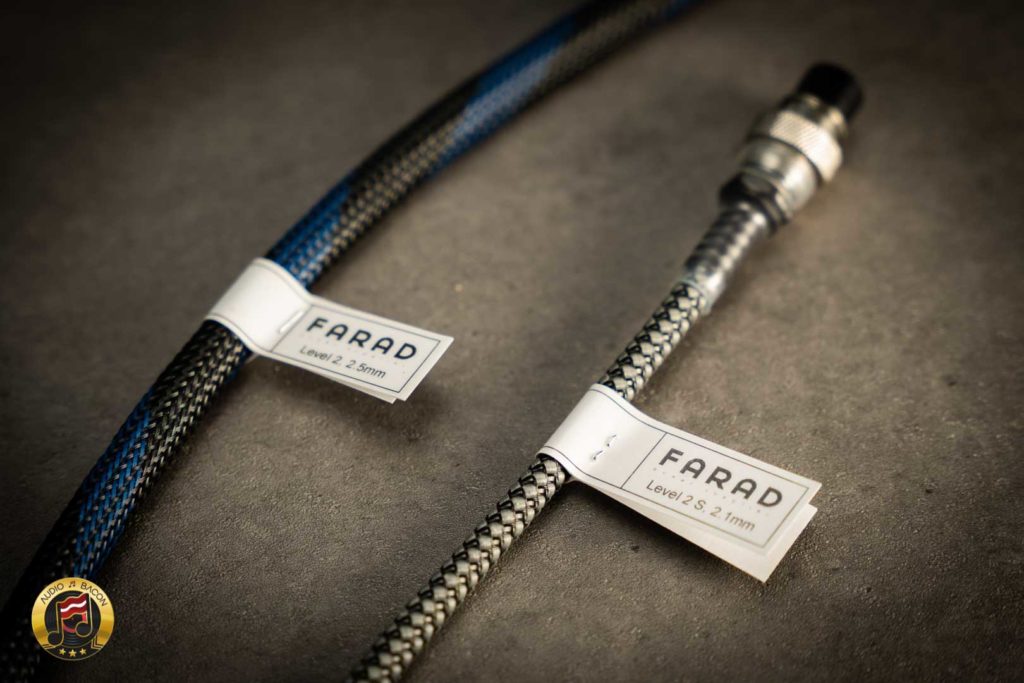
Level 2 DC Cables: Silver vs Copper
These two cables sound very different. The copper will sound more congealed, dense, and slower. There's not a lot of air or clear delineation. In other words, it's very relaxed and mellow with a decent midrange texture. Many will find this cable more natural sounding.
The silver cable offers up what the copper misses - but with a cooler and leaner tonality. There's more grain and edge. The bass is narrower but tighter. It's just a more "alive" sound with more texture, transient speed, depth, and sparkle. It's not as "collected" but offers more spatial clarity. Instruments have more raw resolution and reverb linger and subside more truly.
The copper cable will give you a full and intimate sound. The silver will prioritize vividness, detail, speed, and a cooler sound.
The Sound
I would describe the Super3 as a "natural calm." It's smoother than it is tactile or powdery. Plucked strings and vocal cords have good density and strong extrusion. However, the tonality is more of a greyish tone - and cooler with the silver cable. I would even say it sounds "milky." As far as stride, it's mostly tame but could be assertive at times. Imagine a "cloudy day" type of sound. There's more intimacy and cozy blankets than sunshine and rainbows.
String plucks and strums are thick and have robust extrusion. There's this underlying liquid connection to all the performers. So you won't get clean-cut separation, but it's admittedly very coherent. The midrange is particularly wholesome and romantic. A good example is Zaz's Les Passants where there's good detail and meat all around.
Overall, the Super3 has decent energy, detail, and fullness. It's also very impressive for its size and price. It articulates reverbs and decays very finely with the silver cable. And supplies a palpable midrange with the copper cable. The sound isn't even slightly rough or abrasive - and does a fantastic job of reproducing 3D molds of all the artists and their performers.
Tradeoffs
The Super3 doesn't try to surround the performers with air and space - but instead connects them with the surrounding. It's not smeared because there's still differentiation in shape. But does miss out on some focus. Because of this more polished sound, micro and macro dynamics are thicker than they are fibrous.
The treble is a little tapered and heavier. Bells and woodwinds don't quite have that extra height and extension. Bass matches the midrange in weight - so it may need a bit more slam to stand out. Consequently, you get a sound that embraces a more present and fleshed-out midrange.
Who Should Buy the Farad Super3?
At least in my system, the Super3 did not give an expansive, highly resolving, or spatially clear sound. It wasn't the most transparent and didn't offer precise isolation of the music. I wouldn't describe the Super3 as an energized or “exciting” power supply. But rather one that is meant to be for ease of listening.
For its performance characteristics, I think the Super3 is priced fairly. You won't get as much depth or sparkle as some of the pricier power supplies. But you'll be able to enjoy a good balance of body, detail, and smoothness. I could imagine this pairing well with more high-resolution, analytical, or thinner-sounding systems - as the Super3 will add more meat to the bones and also more of that analog-esque connective tissue.
This is a power supply for those who prefer a neutral color, super smooth sound, and more "connective" outlines. The Super3 is balanced in strength and has good richness and body in the midrange. In conclusion, it's a solid and grounded sound.
Pros
| Cons
|